Search This Blog

EXCURSIONS IN LATERAL THINKING FROM

AMHERST, MASSACHUSETTS AND THE PIONEER VALLEY


Showing posts with label Invisible Gorilla. Show all posts

Wednesday, April 4, 2012

LBJ & The Invisible Gorilla of Succession

Last week’s excerpt in The New Yorker of Robert Caro’s account through the prism of  LBJ's biography of the Kennedy assassination and its immediate aftermath (The Transition) offered one riveting insight after another. My favorite was an Invisible Gorilla moment of inattentional blindness when at Dallas’s Parkland Memorial Hospital, Johnson and his retinue, having just learned that Kennedy had expired and fearing the prospect of a conspiracy, elected to leave the building before the press discovered Kennedy's fate.
Caro writes in The New Yorker:
As the new President of the United States headed out of the hospital, Robert Pierpont of CBS News caught a glimpse of him but did not follow. No other reporter followed him, or apparently knew he was even leaving. "We weren't thinking about succession,"  Newsweek's Charles Roberts explained later.  .  . Nobody attempted to follow him although he was then President of the United States."
[With Kennedy’s death, Johnson immediately became the country’s 36th president. The subsequent oath was a ceremonial formality.]

Only one member of the press, the official White House photographer, Captain  Cecil Stoughton, had the independence of mind  to follow the new president’s decisive exit to his limo and the airport. It was Stoughton who later snapped the iconographic photo of LBJ--framed by Lady Bird and Jacqueline Kennedy--taking the oath of office on Air Force One.


Christopher Chabris and Daniel Simon's Invisible Gorilla experiment asked subjects viewing a video of basketball players to count passes on a gym floor. When a man in a gorilla suit appeared in the frame, a significant number of the observers (typically 50%) failed to notice. The experiment revealed the diminished cognitive/perceptual flexibility that accompanies hyperattentiveness in a demanding cognitive task--a task that was also reinforced by the subjects'  emotional commitment to completing the exercise itself.

The emotional valence at Parkland Hospital was, of course, through the roof—fueled by an uncertain, unfolding, epic tragedy-in-the-making. Little surprise, then, that the press was hyperfocused both emotionally and cognitively on JFK. Since becoming vice president, Johnson had morphed from his leonine days in  the Senate into a nexus of self-doubt. His swagger had become a shrug; he feared expulsion from a second-term ticket. Why focus on a decidedly second fiddle when you might miss the outcome to the story of the decade? But with the news of his own assumption, Johnson was reborn.  His posture straightened,  his facial expression waxed determination and fierce concentration. And he became the  cool, decisive leader that his aides had known in the Senate.
The New Yorker article is excerpted from The Passage of Power, the 4th volume--due out in May--of Caro's magisterial LBJ biography. Without question, Caro is Johnson's Boswell.


Sunday, January 15, 2012

Capital Steps


Built in the late 1960s in the collegiate "bunker" architecture of the Vietnam War Era, the administration building on my campus has weathered decades of anti-war and other student protests.  Inside the building, however, several of the original polymer-based staircases betray 50+ years of continuous footfalls. Notice that the "swayback" steps in the above photos are predominantly on the right side as you're looking down the staircase (on the left side as you're looking up). You keep to your right when descending or ascending. The disproportionate sway on one side, then, must reflect your greater foot impact on steps as you descend. The difference in impact is a factor of two, observes a professor of civil engineering at my university. (See the footnote below for his explanation, which I could not fathom.)*

Resilient scholastic bunker architecture


Staircase design is serious business. The height of risers and depth of treads are standardized in state and local building codes. Nothing jolts your hard-wired sensory-motor expectations like missing a step, or on the upside, encountering one that is unexpectedly high or diminutive. Thirty years ago, arriving in the dark from Canada at the two-story rental where my partner and I occupied the second floor, my suitcase and I went flying when my foot encountered an unexpected supersized first-step riser on the stoop of my building. While I was out of town a handyman had replaced the old stoop with a one-piece modular version. Unfortunately for me, he had failed to sufficiently sink the bottom riser, which was twice the height of the others, into the ground.

Stooping to be conquered?
Post haste I phoned my landlord--an aging curmudgeon--who questioned my sobriety and told me that he'd "look into it." The next morning, I glanced out my 2nd floor window to see the landlord pull up to the house, approach the stoop, and launch face-first over the stoop and onto the porch. He had been forewarned. No doubt, the stoop was his very own Invisible Gorilla.
 ___________________________________________
*Descending, think of sudden loading: use a dynamic load factor of  two (on the  weight only independent of any  factors of safety,etc.). Ascending : first thought  is to consider  a ramp loading. However, since we might run up the stairs, think of sudden loading again and use DLF of 2 again.  So  I would use 2 times as the factor.


Monday, January 10, 2011

Paris 1882: Edouard Manet Meets Bass Ale

(Courtauld Institute of Art, London)

Sure, we’re the same species as the Homo sapiens depicted in pre-20th century paintings, but who hasn’t felt a disconnect when gazing in the art world’s rear view mirror—a chasm separating earlier cultures from our own? In that, transformations in material culture deserve much of the credit. Which is one good reason why Edouard Manet’s A Bar at Folies-Bergere, painted a year before his death in 1883, is exceptional.

Look at the counter of the bar in the above painting. You’ll see two bottles of Bass Pale Ale, with their familiar red triangle logo. It’s a brand that many of us know first hand. Seeing it in the painting connects us in a wink with late 19th century patrons (many of them perhaps British tourists) at Folies-Bergerie. All at once, via a commercial logo, we’ve discovered a bridge over a cultural chasm.

Ironically, many Americans have told me that they’ve seen the painting but haven’t noticed the beer. Some of them are not beer drinkers. Might others who are, however, be subject to the invisible gorilla trap, i.e., failing to see something in front of their noses, because it defies their expectations?

A Bar at Folies-Bergere must also be our longest-running example (albeit inadvertent) of product placement. Marketers at Bass must exult: 127 years of exposure to the brand in galleries and art books—that’s a lot of eyeballs!

Wednesday, June 23, 2010

On Invisible Gorillas, Khrushchev’s Shoe, and Photoshop

Take two and call your lobotomist in the morning. In a classic psych experiment, about half of a subject group charged with counting a basketball team’s passes in the half court failed to notice the accomplice in the gorilla suit who briefly strode onto the court. A presumably honest Hillary Clinton remembered sniper fire overhead when touching down in her 1996 visit to Tuzla in war-torn Bosnia. Reporters recalled a different story: a peaceful landing and welcoming ceremony graced by a child reading a poem.

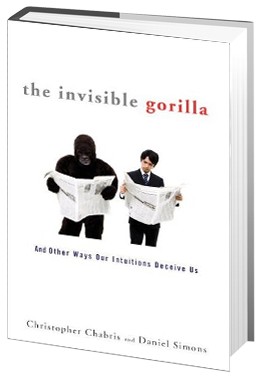
These and much more are grist for Christopher Chabris and Daniel Simons’ new book, The Invisible Gorilla, an exploration of the distortions and outright illusions that accompany our individual and collective perceptions and memories. Don’t be fooled, note the authors: our brains are not cameras—they construct and reconstruct memories and perceptions with creative aplomb—sometimes they addeth; other times they taketh away.

If the shoe won’t fit . . . Reading the New York Times’ thumbs-up review of the book several Sundays ago ignited my own memory of perhaps the greatest collective illusion of the Cold War era. Remember footage or photos of Khrushchev banging his shoe during his 1960 speech at the United Nations? Nikita with shoe is one of the iconic images of the era. But according to former Washington Post journalist Peter Carlson in his entertaining K Blows Top, there was no video and no photo of the “act.” Alas, we’ve inherited just one photo of the shoe—a loafer, which sits inertly on the desk in front of K.

Khrushchev’s son, Sergei, who has lived in the United States since 1991, notes Carlson, regularly asks audiences if they recall images of his father banging the shoe. “I say, please raise your hand if you saw it, and many people raise their hands. They really think they saw it,” he remarks in Carlson’s book. Try your own version of the question at your next party. Some of your friends will bet the house that they saw K’s shoe in action. Their certainty will reflect  the viral potency and reinforcement of the human herd's collective memories.


Two weeks ago, I became excessively agitated upon discovering the Web photo (above right) of Khrushchev in the act—so agitated that  I emailed Khrushchev’s biographer, William Taubman, at Amherst College. The professor’s response was decisive:

I'm certain it's been photoshopped. Because even if he did bang his shoe (which I doubt), he is alleged to have done so while seated at a desk rather than standing at the lectern. But after interviewing a lot of people about the whole episode (many of them after my K bio came out), I believe K only brandished his shoe but did not bang it.

Learn how Professor Taubman arrived at his conclusions in his sparkling, meticulous opinion essay in the July 26-27 issue of the International Herald Tribune here.

A Note to Self-Important Photoshoppers. Be advised that Photoshopping a loafer into K’s hand and launching the photo into cyberspace may reflect your affinity for a consummate Stalinist tradition. Prominent party members among Stalin's millions of purged victims regularly got the air brush in official photographs. Consider the before-and-after frames below of Nikolai Yezhov, head of the NKVD (forerunner of the KGB), who was purged in 1939 and executed in 1940. The photos are highlights in the Newseum’s intriguing Web exhibit, The Commissar Vanishes. Visit it here.


And take it from Chabris and Simons—getting a handle on perception and memory can be a tall order unto itself. Additional “noise” is not required. Please hold the Photoshop!

Subscribe to Wig & Pen.