Search This Blog

EXCURSIONS IN LATERAL THINKING FROM

AMHERST, MASSACHUSETTS AND THE PIONEER VALLEY


Friday, February 18, 2011

Old Man Walking—Just like a Train

Get Out of My Way, You Jerk, a recent article in The Wall Street Journal, examined the causes and consequences of pedestrian sidewalk rage. The feature cited average rates of locomotion in Manhattan for men (4.42 feet per second), women (4.10 fps), cellphone users (4.20 fps), tourists (3.79 fps), and others.

And it sparked my memories of an elderly Brit with two oversized canes and the air of a professor emeritus whose forward progress gave new meaning to the word glacial. Until last June’s heat wave, he would walk each day onto my campus (the University of Massachusetts at Amherst), eventually stopping for lunch at a campus cafeteria.

Although he moved at a tempo apart, no one who ever saw him failed to admire his grit and his walk ethic. Still, when he extended a cane onto the crosswalk at Massachusetts Avenue—a large thoroughfare that bisects the campus—he became the scourge of most drivers at directional cross-purposes. At those crossings, prominent Ped-X-ing signs and tight campus police enforcement ensure that foot traffic rules.

So how long might a driver on the wrong side of the cane wait for our friend? One day I timed his passage across the two east-bound lanes (15 feet across total). Getting across both took him 42 seconds—an eternity if you’re behind the wheel, perhaps an eternity and a day if you’re a student behind the wheel.

A 42 second stroll--15 feet across


Just like a train. “For me it’s not unlike coming up short at a train crossing,” observes a friend who studies the behavior and psychology of decision making by accountants. “At first there’s shock and disappointment that you just might have an indeterminate wait on your hands. How you adjust—how you shift gears mentally and emotionally—is critical, of course, to your short-term disposition. Why not count train cars from Peoria or root for the aging professor as he goes for the gold?”

Sometimes, though, a more pragmatic response can present itself. If you’re in the far lane, and the cane has just touched down on the crosswalk, you have 21 seconds before it reaches your lane. Many drivers, in fact, grab daylight while they can. But a strict interpretation of Massachusetts law, i.e., “law driving,”--the stuff you learn to get your license—requires that you stop your vehicle whenever anyone sets foot (or cane) on a crosswalk. Fortunately, there are broader interpretations of the law: “In a situation like that,” observed a campus police officer, "my recommendation is—use good driving judgment!"


Sunday, February 13, 2011

New iPhone App Will Not Replace Confession; Will Not Replace Priests

Say what you will about the Catholic Church--unlike many American institutions, it has protected its key employees—i.e, the priests, from the scythe of downsizing via outsourcing and replacement by new technologies. Heaven knows the American Catholic Church has bills to pay. To this end, it has embarked on an unprecedented fire sale of church property and parish consolidations. Priests, of course, have been shunted about, but it’s mostly the property that’s been downsized.

What a comfort, then, to learn that the Vatican disapproves of a new application that allows for fingertip preparation via iPhone for confession. Cooked up by the Indiana company Little iApps, the program, Confession: A Roman Catholic App, recently debuted after securing approval from Bishop Kevin Rhoades of Ft. Wayne, Indiana. But the Vatican doth protest:

I must stress. . . to avoid all ambiguity, under no circumstance is it possible to confess by iPhone, emphasized Vatican spokesman Federico Lombardi last week.
The Vatican’s principal motive, of course, is not pecuniary but spiritual. “It is," continues Lombardi, "to require a personal dialogue between penitents and their confessor, [which] cannot be replaced by a computer application.”

Rightsizing: A Confession. But if a full-confession app did catch on and became confession-as-usual, it would no doubt cut into a priest’s workload. When Wig & Pen’s own priestly friend Guido headed up a medium size parish, he devoted three to five hours each week (more during the Lenten season) to the confessional. If you multiply 4 hours per week by the nation’s 19,000 Catholic parishes in 2006 (the number of parishes has undoubtedly declined after the recent consolidations), you get 77,000 hours. That would be quite a bone for Corporate America’s spread sheet “right-sizers,” who might crunch even a fraction of hours saved into fewer priestly positions.

Fortunately, the church has conservative values of a different stripe. How sinful it would be, for example, if an app were to obliterate the practices that inspired Jerry Seinfeld’s brush with the confessional in the clip below.


Wednesday, February 9, 2011

A Nixon in China Artifact


This year’s long-overdue Metropolitan Opera production of John Adams’ Nixon in China (introduced by the Houston Grand Opera in 1987) is a big deal. It is coming (simulcast) to a cinema or auditorium near you this Saturday afternoon at 1 p.m. (A reprise performance is planned for early March.) In Nixon, Adams moved well beyond minimalism, incorporating wafts of big band jazz; didactic, politicized Chinese ballet; and  reflective airs bordering on melancholy. Adams and librettist Alice Goodman teamed up with great deftness to portray characters that almost never became caricatures—quite an accomplishment considering the principals: Mao, Chou Enlai, Chiang Ch’ing (Mao’s wife), Pat Nixon, Henry Kissinger, and Nixon Agonistes himself.

The bamboo curtain was cinched tightly around China before Nixon’s seminal visit in 1972 (think of today’s North Korea). Nixon—the bĂȘte noir of anyone left of center—deeply offended many Republicans with his visit—the price of which was to boot Taiwan (then known as the Republic of China) out of the U.N. Security Council and the U.N. itself. (Taiwan still hasn’t gotten back in; it needs China’s Security Council vote for readmission.)


Presidential Material: A Li River boat cruise
Wig & Pen Stumbles upon a Nixon in China Artifact Several years ago, this writer walked into a drab, two-room commercial gallery in a waterfront community on the outskirts of the southern Chinese city of Guilin, gateway to the Li River. (Although most Chinese have never visited the city, many American presidents have. Chinese hosts consider a boat cruise for top visiting dignitaries past the river's “floating-world” karst outcroppings as de rigueur.)

The gallery offered much forgettable artwork, but then I saw something really special. It was a framed gloss photo of the Nixons in 1972 on a Li River tour boat surrounded by a dozen crew members in cloned satin uniforms. As a friend and I admired the photograph, the gallery’s owner, a woman in her mid-40s who spoke no English, pointed to a uniformed teenage girl standing just behind the Nixons. Then she pointed to herself. In 1972 she had been an eyewitness to a historical watershed; 34 years later she had traveled far beyond, along a propulsive river of cultural and economic transformation.


A helping from the Met's Nixon in China Banquet Scene:

Friday, February 4, 2011

Greetings from Quebecachusetts!

A tip for New Englanders who are stressed out over the elements. Seek out a Canadian for a saner hibernal perspective. It worked wonders for me, especially after I had convinced myself that this Massachusetts winter might well rival a winter in Quebec.

Thankfully, my septugenerian Canadian mentor, born and bred in Fredericton, New Brunswick, set me straight. Yes, she conceded, the past month has suggested a winter in Quebec. But a timid one.

Now I'm warming up (maybe not); I'm less hounded by meteorological injustice.

Also, when you consult with your Canadian, remember that his kind are among the planet’s savviest cold-weather pragmatists. They have black belts in removing just enough snow from roofs, wrapping wet pipes with towels and other reachables, and striking a golden mean in sartorial layering.

And they offer advice with scarcely a trace of superiority. To do otherwise, of course, would be un-Canadian, even American.  All the better for them:  revenge, as they know, is best served cold.

Choose a Canadian regional forecast from the Weather Channel here.

Saturday, January 29, 2011

Owls and Messiaen Offer Levitation, Inspiration


One week ago at 3 a.m., I heard an owl from the trees behind my house. It offered several repetitions of the same sustained note in a dulcet alto that belied the bird’s predatory ways. Then, I heard a second note—a perfectly pitched fifth above the first—presumably from the same owl. But I was wrong. The fifth had come from a second owl. And then it happened. The two owls combined their notes simultaneously to create a stunning tonic-dominant interval. After several minutes of unrequited waiting for a reprise, I staggered back to bed in shock and delight.

Several days later, I got the skinny over the phone from naturalist Ted Watt at Amherst, Massachusetts’ Hitchcock Center for the Environment, which adjoins the wooded area behind my house. After quizzing me with a couple of his own diagnostic hoot impressions, Ted identified the birds as Great Horned Owls. January and February, he noted, is their time to nest, so I had been an aural voyeur to a mating ritual. Ted had never heard the simultaneous tonic-dominant interval himself and suggested that I try to record it. A small tape player now sits next to the water pick in my bathroom.

My Own Private Messiaen. My epiphany brought to mind the avian obsessions of the great French composer Olivier Messiaen (1908-1992). A devout Catholic mystic and tireless amateur ornithologist, Messiaen visited bird habitats on at least four continents and jotted down the note patterns of bird songs and bird conversations for over 100 species. (Bartok, who wrote down folk music in the field in European and Northern African villages, did analogous work with Homo sapiens.)

Avian inspiration is conspicuous in many of Messiaen’s greatest works. His most popular opus, Quartet for the End of Time, (1940-41) offers a 7+ minute clarinet soliloquy that explores a bevy of avian activities. (see the video performance at the bottom of this post.) His extended work for solo piano, Catalog l’oiseaux, (1956-58) musically paints the personalities of 13 species, including the tawny owl (La chouette hulotte), portrayed by Messiaen with considerable left hand gravitas, yielding occasionally to upwardly mobile clusters that suggest enchantments of a starry night. (Messiaen’s pianist-wife and collaborator, Yvonne, introduced the Catalog and many other Messiaen piano works to the public. Her surname, Loriod, received proper homage in the Catalog via a musical tribute to le loriot, the golden oriole.)

Messiaen’s lavishly orchestrated Des Canyons aux Etoiles (1971-1974) depicted the U.S. western desert, and Utah's Bryce Canyon and nearby Zion National Park. The musical excursion explored geology, the night sky, and, of course, avifauna. The VIB’s included orioles, robins, mocking birds, and several smuggled-in Hawaiian birds that the composer had encountered in the Pacific. And in what many consider to be Messiaen’s culminating masterwork—Saint Francis of Assisi (1975-1983), (for spirituality it rivals any mass that I know of), the composer devoted an extended final scene in Act II to the saint’s ravishing Sermon to the Birds. For Messiaen, birdliness was next to godliness. Take it from Saint Francis and Messiaen in the passage below:

Brother birds in all times and places, praise your creator. He gave you the freedom of flying. . . He made you a present of the air, the clouds, the sky. . . He allowed you to sing so marvelously that you speak without words, like the speech of the angels, by music alone.


Wednesday, January 26, 2011

On the Aging of Aquarius

My first memory of collective Boomer decline came in Martin Scorsese’s The Last Waltz, shot in November of 1976. Close up after close up revealed road maps of dissipation on the faces and physiques of iconic music makers of My Generation. When Van Morrison, portly and prematurely middle aged, bounced out on stage, the graffiti was on the wall: the Boomers might just be mortal after all, like any other generational cohort. Five years later, after gaping at the vast latitudes of Gerry Garcia and David Crosby, I fantasized a dark futuristic tale in which the last veteran of the Woodstock Festival—a la the last Civil War and WWI veterans—would reminisce to skeptical younger generations about uncertain glory days.

I am, in fact, a Woodstock alumnus, but odds are overwhelming that I will not be the final survivor of that mud fancier’s Valhalla. In fact, I’d bet my son’s inheritance that the last man standing will be a woman. For the U.S. population 65 and above, women outnumber men 4 to 3. But if you’re a guy and you make it to the final cut of supercentenarians (age 110 and over), you’ll be utterly eclipsed. Only five males grace the Gerentology Research Group’s international roster of 85 supercentenarians.(←Click there.)

While that ratio may prove enticing to some incontinent members of the Y chromosome elite, it offers Wig & Pen scant titillation. Back when Boomers still boomed, this blogger, just out of high school, rebuffed the advances of the poet Robert Bly after a reading at Worcester State College. Years later, Bly became a founding father of the men’s movement. No surprise then that Wig & Pen has looked askance at their incendiary desert romps and pachydermal forest pursuits. But given my gender’s long-term prospects, perhaps a men’s group is in order, maybe even our own Woodstock.


Burning Y Chromosomes in the Desert

Saturday, January 22, 2011

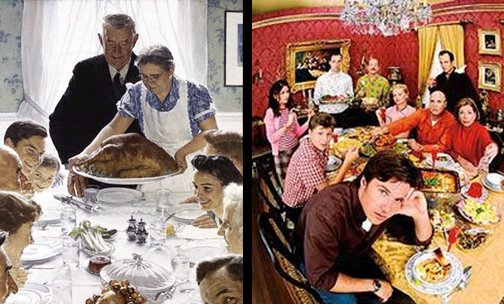
Annals of Seasonality: Are Family Therapists Prey to a December Effect? A January Effect?

Click to enlarge. (On the right--The Bluth Family)
It's common knowledge that holiday season revenues, not Santa, are a retailer’s saving grace. According to Jon Hurst, president of the Retailers Association of Massachusetts (this blog’s home state), holiday sales account for about 25 percent of annual business for the average Massachusetts store.

But the retail world is not alone as the recipient of a holiday spike. That’s at least the contention of seven therapists and a priest who counseled this blogger for free about the matter (although one of them seemed on the verge of advising, I’m sorry, but we have to stop.)

The inspiration for the current investigation was my pal the priest—the same spiritual visionary who graced this blog last April in a post on spiffy vestments. In our tete a tete about the holiday spike, Father Guido (I’ve changed his name) confessed that he used to get so overloaded from counseling despondent family members during the holidays, that he would religiously repair to a nearby monastery in January to decompress.

When a retired therapist noted that she also left the stadium in January after working with dysfunctional families in December, I asked myself, Have I discovered a January Effect as well as a December Effect?

Not so, according to the six other therapists, who insisted that they soldier on with their clients into the new year. But all seven therapists and my friend the priest swear absolutely by the December Effect. And what a pity, one of them noted, that the American pastime of recreational shopping is useless as an emotional safety valve in December. How could it be anything but part of the problem? he lamented.

Wednesday, January 19, 2011

Hitchcock and Hopper: Side by Side

Click to enlarge
When Edward Hopper and his wife Jo read in the New York Evening Post that Alfred Hitchcock had credited Edward’s 1925 painting House by the Railroad as the principal inspiration for the Bates house in Psycho, the couple was delighted, notes Hopper biographer Gail Levin. The painting with its isolated subject is widely said to depict loneliness and modernity’s abandonment of the Victorian sensibilities of Hopper’s youth. You can view the painting  in New York's Museum of Modern Art, but you can't visit the actual house. It was a creation straight out of Hopper's head. But the movie takes matters much further. When I look at Chez Bates’ singular, decaying mansard pointing skyward, I see death’s boney, accusatory finger. How about you?

Thank goodness for the less sinister architecture of the motel. In the movie preview below, Hitch takes us on a tour of the Bates complex. There’s much to learn from his hospitality—not the least that the director’s manipulation of his audience extends to enticing his public into the cinema. In other words, the Master of Suspense was also a master of marketing.

Monday, January 10, 2011

Paris 1882: Edouard Manet Meets Bass Ale

(Courtauld Institute of Art, London)

Sure, we’re the same species as the Homo sapiens depicted in pre-20th century paintings, but who hasn’t felt a disconnect when gazing in the art world’s rear view mirror—a chasm separating earlier cultures from our own? In that, transformations in material culture deserve much of the credit. Which is one good reason why Edouard Manet’s A Bar at Folies-Bergere, painted a year before his death in 1883, is exceptional.

Look at the counter of the bar in the above painting. You’ll see two bottles of Bass Pale Ale, with their familiar red triangle logo. It’s a brand that many of us know first hand. Seeing it in the painting connects us in a wink with late 19th century patrons (many of them perhaps British tourists) at Folies-Bergerie. All at once, via a commercial logo, we’ve discovered a bridge over a cultural chasm.

Ironically, many Americans have told me that they’ve seen the painting but haven’t noticed the beer. Some of them are not beer drinkers. Might others who are, however, be subject to the invisible gorilla trap, i.e., failing to see something in front of their noses, because it defies their expectations?

A Bar at Folies-Bergere must also be our longest-running example (albeit inadvertent) of product placement. Marketers at Bass must exult: 127 years of exposure to the brand in galleries and art books—that’s a lot of eyeballs!

Monday, January 3, 2011

Americans Weep for Enrique Morente?


Few Americans will lament the death on December 13 of Enrique Morente, age 67, Flamenco’s leading male vocalist (cantaor). That’s because few Americans have heard of Morente or, for that matter, of his fellow cantores. But for flamenco, losing Morente—a traditionalist and a modernizer; a guardian and disseminator of Lorca, Antonio Machado, and other Spanish poets; and a world music innovator—was a supreme loss—analogous to the passing of Astor Piazzolla in tango or the recent death of Ali Akbar Khan in Indian classical music.

When most Americans think of flamenco, percussive dancers or extraordinary guitarists like Paco de Lucia, Paco Pena, and Gerardo Nunez come to mind. But ultimately it is the voice that occupies the high-intensity still-point of the Andalucian art form. And in that genre, vocal sonority frequently takes a back seat to unvarnished passion. It is precisely that raw vocal intensity that transports the cantaor and his audience to the euphoric musical experience that flamenco culture calls duende.

If bel canto has an antonym, this is it. Paying ear-witness to many a cantaor is much like imagining Tom Waits with strep. In other words, my fellow Americans, you’ve had zero exposure to flamenco singing because the American music establishment considers it Not Ready for Prime Time. So there!


A Cantaor apart. But Mr. Morente was a musician apart who combined a powerful baritone with remarkable vocal control and nuance—assets that ultimately enriched his art. Here’s Robin Totton’s assessment of those skills in his valuable guide to flamenco, Song of the Outcasts:

This is not to say that fine singing choices don’t exist: Enrique Morente’s baritone (and his musicianship) could have put him in the class of Placido Domingo or Jose Carreras, had he so chosen.

Recent Recordings. Morente and his tragic contemporary, Camaron de la Isla (1950-92), are widely regarded as flamenco’s greatest post-war and (eventually) post-Franco cantaores. Both had deep roots in flamenco tradition; both also exasperated purists by experimenting with juiced up instruments, including electric guitars and electric basses. One of Morente’s greatest nontraditional achievements is the 1996 cd, Omega, which features a rock group and synthesized effects on half of its tracks. Many of those cuts, including the nine-minute eponymous Omega, highlight poems by Lorca. Others offer bold interpretations of songs by Leonard Cohen. (The flamenco-infused takes on Cohen’s First We Take Manhattan and Hallelujah!, the latter with small chorus, are surprising, unforgetable listening experiences.)

Estrella Morente
In the United States,  Morente’s most widely distributed cd is the splendid Morente--Lorca (1998 on the Narada label), which gives flamenco treatment to verse by the blind poet, murdered by Franco's thugs in 1936. Another recent standout is Pablo de Malaga (2008), which celebrates Pablo Picasso’s poems and paintings. In his latest outing, Morente Flamenco (2009), the cantaor is in supreme form with traditional repertoire on stage. His voice exudes a basaltic dark power, frequently on the verge of revisiting its magmatic origins, but always lasing the soundscape with controlled emotional intensity. Morente is survived by his daughter Estrella, who shares many of his musical sensibilities and has sold many more recordings than her father thanks to her vivaciousness and status as a world music superstar.


Morente Videos:

The first video below features Enrique Morente and the guitarist, Tomatito in Suena la Alhambra, an evocative Morente pipe dream. The second, which explores flamenco’s affinity with Northern African music, offers Morente in tandem with Khaled, the planet’s leading exponent of (Algerian) Rai.


Thursday, December 23, 2010

Kvetching about Santa


From The Polar Express--Warner Movies
 In his brilliant, riotous book, Born to Kvetch, professor and stand-up comic Michael Wex pays homage to Yiddish as an essential ingredient in a subversive glass-is-half-empty under-culture. Today and during my childhood, that influence lives on via the dark nuances of Jewish American humor and in the critical skepticism of Americans of Jewish ancestry. Glass-is-half-empty Jews? To this end, we must also give credit to the  Jewish American Santa Syndrome.

Item: At age four, after asking my father how Santa could possibly gain passage through our elfin chimney, I learned that life was unfair:

 Santa Visit here? We celebrate Chanukah.

 Item: Two years later, after inquiring whether we might petition Santa for a cameo appearance, I learned still more from my paternal grandmother:

Ho! Ho! Ho! The big guy is pure fiction. But don’t tell your non-Jewish friends. You’ll upset them and, besides, they won’t believe you.

Santa, a fraud?  That proved hard to swallow, much like the jarring but gradual realization that Killer Kowalski and Bruno Sammartino were by and large well-conditioned thespians.

 Item: A critical experiment at age seven. Having hung two stockings by the fireplace on Christmas Eve, I awoke on Christmas Day to find them half empty with gravel (beloved paternal grandmother at work again).


Given my no-nonsense upbringing, I am delighted to share the holiday bobbles below, retrieved in a quickie Lexis/Nexis search:

Authorities Seek Bank Robbing Santa 
UPI—December 23, 2009 Hermitage, Tennessee
"I don't remember a Santa doing that," said Police spokeswoman Kristin Mumford. "I don't recall when a costume like he had today was used for a robbery.” However, the costume is a popular disguise among criminals nationwide. Police in Pennsylvania said a gun-toting Santa robbed a bank earlier this month. One of the most infamous heists in history, the Dec. 23, 1927, Santa Claus bank robbery in Cisco, Texas, resulted in the deaths of six bystanders.

Man dressed as Santa Claus arrested for trying to run over police chief

Associated Press, Chester, Pa. December 26, 2001
Police said William Hatzell, 57, was wearing a full Santa suit when he was stopped and questioned by Bethel Township Police Chief David Houser on Saturday. When he was asked for identification, Hatzell refused to hand it over, and instead backed his car into Houser.

Santa impersonator robs gas station                                                                                                                                               Evening Post (Wellington) December 22, 1997
As robbery disguises go, this one lacked originality, but still served to throw off the chase.


Fraud suspect plays Santa Claus
UPI—Nashville, December 6, 1984.
Garland Shushan, who said he felt like Robin Hood, has been arrested for playing Santa Claus with other people's credit cards--a scam he learned watching the television show ''60 minutes.''

Research Brief:
Claus-trophobia: Sitting on a fat stranger's lap is scary for many kids
The Standard (St. Catharines, Ontario) December 23, 2004
For the second consecutive Christmas, behavioural researcher John W. Trinkaus is investigating the relationship between children and shopping-mall Santas. For more than 90 per cent of the youngsters studied, he reports a visit to St. Nick was met with indifference, hesitance and even Claus-trophobia.

 You may be wondering why Wig & Pen has failed to include among these chestnuts an example of inappropriate contact between Santa and his young visitors. It’s simple: Wig & Pen disapproves. And most emphatically, Wig & Pen is a family blog. Still, every rule has its exceptions:

Woman accused of groping mall Santa
The News-Times, Danbury, Connecticut, December 18, 2007
A Danbury woman was charged with sexual assault after allegedly groping Santa Claus at the Danbury Fair mall. Danbury police were called to the mall over the weekend. The mall Santa told them Lamy had touched him inappropriately while sitting on his lap. Capt. Bob Myles said police were able to quickly find and identify Lamy because she was on crutches. She has been released on a promise to appear in court on Jan. 3. 

Are you a mall or department store owner who's had enough? Get legal advice here.

Warmest Holiday Wishes from Wig & Pen!


Friday, December 17, 2010

The Mind's Eye, Ears, Nose & Throat: Use Them or Lose Them!


In his latest book, The Mind’s Eye, neurologist and psychiatrist-physician Oliver Sacks explores the resilience of human compensatory powers that arise after the loss of senses and perceptual-cognitive abilities that we take for granted. These include speech, the ability to recognize faces (Sacks’ own personal challenge), perception of three-dimensional space, reading, and eyesight. The book’s final, eponymous chapter, much of which appeared in a 2004 New Yorker article, focuses on how different individuals who lose their sight develop very different perceptual-cognitive coping powers and strategies.

The chapter first draws on four memoirs, the first of which depicts John Hull, a professor of religious education in England, who after losing his sight at 43, fell fast into what Sacks describes as an “acquiescent descent into deep blindness.” After that Sacks takes a u-turn, describing three who have lost their sight but [counterintuitively to many among the sighted] have compensated by developing extraordinary visual powers in their “mind’s eye.” The first learned to construct a vivid visual world with engineering precision. The second learned to visualize equally vivid, but aesthetically couched, mental pictures of landscapes and rooms, environments and scenes. The third developed supernormal powers of visualization and visual manipulation—the ability to visualize and manoeuver people, objects, landscapes.

Oliver Sachs also interviewed Dennis Shulman, a clinical psychologist, psychoanalyst, and rabbi, who observed:

. . . I have very visual memories and images. . . My wife, whom I have never seen—I think of her visually. My kids, too. I see myself visually—but it is as I last saw myself, when I was 13, though I try hard to update the image.
When giving public lectures, Dennis confesses to “seeing” his Braille notes visually. He also can recognize many of his patients by smell.

Dennis Shulman and the wasps. The author of this blog was friends with Dennis when he was 13. Many of our mutual friends knew that he was approaching blindness, but were not sure to what degree. Like a family secret, it wasn’t discussed. At about that time, Dennis was central in a short-lived childhood trauma. Seated with several friends at a picnic table in my back yard, he stuck his foot in a yellow jacket hole. Our flight instinct was automatic--so all-consuming, that we didn’t realize that we had left Dennis behind until we saw him through my kitchen window, still flailing at wasps back at the picnic table. Fortunately, my mother’s protective instinct was as involuntary as our own had been—she had him back inside the house before any of us could blink.


Bardic Skills in Jeopardy? While reading Nine Lives, William Dalrymple’s eclectic collection of portraits of spiritual practitioners in India, I came across an example that dovetailed with The Mind's Eye. Dalrymple’s portrayal of Mohan Bhopa, a Rajasthani singer and performer of epics, reveals the bard’s almost preternatural recall of The Epic of Pabuji, a 4000-line, 600-year-old poem that typically takes five nights of eight-hour dusk-to-dawn performances to complete. Ironically, increasing literacy appears to be in part responsible for the demise not only of the bardic tradition but for gaps in the collective bardic oral memory.

Citing the work of Harvard classicist Milman Parry, who in the 1930s went to Yugoslavia to study bardic oral traditions, Dalrymple observes:

I asked whether the bhopas (bards/singers of epics) were illiterate. Milman Parry had found in Yugoslavia that this was the one essential condition for preserving an oral epic. It was the ability of the bard to read, rather than changes in the tastes in his audience, that sounded the death knell for the oral tradition. Just as the blind can develop a heightened sense of hearing, smell, and touch to compensate for their loss of vision, so it seems that the illiterate have a capacity to remember in a way that the literate simply do not. It was not lack of interest, but literacy itself, that was killing the oral epic
  Performing the Epic: See John Smith's article and photos.

If you consider yourself among the handful of readers reconciled to this blog, W&P invites you begin the hadj of committing it to memory. W&P may be just the thing to populate those vast unproductive expanses between you and your therapist.

Friday, December 10, 2010

Bravo, Don Willie!


The New York Times November 21 obit for Norris Church Mailer, the Arkansas beauty who married Norman Mailer, not only sheds light on her marriage but on President William Jefferson Clinton. In what some might consider a coda of stunning irreverence, the obit concluded with an extract from her memoir, in which a female friend in Arkansas politics told the late Ms. Mailer:

“I guess he [Clinton] slept with every woman in Arkansas except you.” . . . “Sorry,” [Norris Mailer] replied. “I’m afraid he got us all.”

Which leads me to my beef with Billy Blythe, the one-act opera (so far just for voice and piano) that debuted in fragments on November 19 at the Women’s City Club in Little Rock. (No new performances as of this writing) Composed by Arkansas natives Bonnie Montgomery and librettist Brit Barber, the opera distills a day in the life of young Bill at 15, shedding light on the tangos and imbroglios of the troubled Blythe/Clinton household. Highlights include Willie’s confrontation with his alcoholic step-father and the future president’s contemplation of his mother’s stratigraphic application of makeup.

Don’t get me wrong—my sympathies are with those who seek the cosmos in a grain of sand, but any opera that trains a psycho-historical micro-lens on William Jefferson Clinton is missing the point: Mr. Clinton and his supersized appetites—from belles to books to burgers--are made to order for the grandest of grand opera. More to the point, hasn’t Willie proved his worth as the Don Giovanni of our times?


Hail, to the Don. The Don transcends all cultures, all eras—he is an archetype among Homo sapiens. In this, Clinton is a lock—a gift to any enterprising composer or librettist. Some Wig & Pen suggestions: Build febrile momentum by cherry picking among pregubernatorial razorback belles, Troopergate dalliances, and subsequent action in the Federal Triangle. Cast roles for Donna Paula, Donna Jennifer Fiori and Donna Monika.

Kenneth Starr is made to order for Satan: a devil who will FAIL. Who will twinkle as Willie’s Leporello? Not the sanctimonious Al Gore, who ditched the tottering Clintonian loveboat of state. But let’s bring him back for the final scene, when Willy and Donna Hillary walk hand in hand along a Martha’s Vineyard beach—while 400 miles south, on a Virginia strand, a supersized Al Gore ambles alone.

Sunday, December 5, 2010

In China, Nothing Protects like Protection


If you seek nuanced armchair immersion into China’s dynamic culture, read New Yorker magazine columnist Peter Hessler’s latest book, Country Driving. With virtually no authorial ego, Peter illuminates the greatest rural-to-urban migration of our times through a narrative loaded with poignant stories of individuals and families and framed with astute economic and cultural insights.

They’ll be watching you. So what’s the deal with the book’s mysterious dust jacket? According to Hessler, who snapped the photo while driving south of Batou, the biggest city in China’s province of Inner Mongolia, available traffic police are no match for vast expanses of highway infrastructure.

Here’s how he depicts the situation in Batu:

. . . in the hopes of managing the new traffic in the way that scarecrows manage birds, the government had erected fiberglass statues of police officers. . .located at major intersections and roundabouts, where they stood at attention atop pedestals. They portrayed officers in full uniform, complete with necktie, visored cap, and white gloves. Each statue wore an ID tag with a number. In Batou, I never saw a live cop.
And south of the city while driving through the Ordos Desert:

. . . periodically a policeman statue loomed beside the road. There was something eerie about these figures: they were wind-swept and dust covered, and the surrounding desert emphasized their pointlessness. But their posture remained ramrod straight, arms at attention, with a sort of Ozymandian grandeur—terra-cotta cops.

Friends you can rely on.

An enduring tradition’s New, New Thing? Before you consider this practice completely off the wall, remember that China has a deeply entrenched history of outdoor statuary—complementary with Feng Shui—that is supposed to confer protection through powerful, supernatural authority figures—dragons, Fu dogs, etc.

During my two weeks in China in 2006, I marveled at such security outside factories and homes, palaces and banks. It would be ludicrous, of course, to infer that the government of Inner Mongolia attributes supernatural protective powers to its fiberglass cloned cops. But it’s no stretch to speculate that the polymer police are an exotic new twist in an enduring tradition of sculptural guardians/authority figures.

Wednesday, December 1, 2010

Manly Men in the Oval Office

Manly Men (left: from Pete Sousa, The White House File)
Call it audacity of hope; call it a quickening of the presidential mojo—President Obama was back on a basketball court a scant two days after taking that elbow to the mouth and an added helping of 12 stiches. There’s no denying the President’s mental and physical resilience. And there’s no denying the arduous physical demands (and risks) that full-court pick-up basketball can impose on a 49-year-old.

Still, no American president—Obama included—has approached the manly altitudes of Theodore RooseveltAnd no president before or since has lost an eye while boxing in the White House. As president, TR also favored horseback riding in Rock Creek Park, swimming and rowing in the Potomac, jujitsu and wrestling in the White House, and tennis, hiking, and, of course, hunting. When running for president in 1912 on the Progressive Party ticket, he delivered an hour-long speech with a wannabe assassin’s bullet in his chest and blood spotting his shirt. (The 50-page speech, tucked in his jacket pocket, may have been a life saver.) Clearly, TR could take a good shot, both inside and outside the ring.

A Gentleman’s Education. TR began boxing as a student at Harvard, nearly winning the college’s championship. As governor of New York, he sparred several times each week, a habit that he brought with him to the White House, where he periodically moved furniture around his upstairs private office to create a makeshift “ring.” His regular sparring partners were typically U.S. Army officers, including one Captain (later Colonel) Dan T. Moore, who in 1917 confessed: “I boxed with the President on average, three times a week throughout two winters 1904-05 and 1905-06. . .I must have had the gloves on a hundred times.”

Gloves offered protection for the presidential hands but not for the presidential left retina, which became partly detached during one of TR’s 1904-1905 office sparathons. TR kept the incident and his subsequent loss of sight under wraps until well after his administration. But that didn't interrupt him from his weekly communion with the sweet science.

Manly Men Make Peace. In 1903 Roosevelt received the Nobel Peace Prize for having negotiated the end of the Russo-Japanese War. In 2009, Obama was similarly honored. Boxing in the White House? The White House and the Nobel Peace Prize are not what they used to be.


Tuesday, November 23, 2010

Do We Really Deserve a Netrebko Effect? A Rollins Effect?

Anna Netrebko
In 2007, the outstanding American tenor Brandon Jovanovich won the annual Richard Tucker Award, reserved for “an American singer poised on the edge of a major national and international career.” Past Tucker honorees include Renee Fleming, Jennifer Larmore, and Stephanie Blythe; so Mr. Jovanovich’s accomplishment was no small beer.

Yet, on November 15, in an article by Associated Press veteran reporter Mike Silverman, we learned that “Brandon Jovanovich, a young American tenor” fell victim to what Silverman described as The Netrebko Effect. The bottom line: In a variety show opera gala on behalf of the Richard Tucker Foundation, Brandon had the misfortune of following performances by the charismatic, supremely gifted soprano Anna Netrebko not once but twice. You can read the performance details here. The review offered advice as well as faint praise:
“. . . try to make sure you don’t go on right after Anna Netrebko,” cautioned Mr. Silverman. . . “Jovanovich followed, singing an aria from Lehar’s last operetta, Gluditta, with ardor and impressive volume. But it inevitably seemed a bit anti-climactic.”

A Rollins Effect? It also sparked my recollection of a 1989 Times review when the saxophonist Branford Marsalis sat in at Carnegie Hall with Sonny Rollins and his quartet. Marsalis, an accomplished reed man,  proved no match for the Saxophone Colossus. Times reviewer Jon Pareles was there:

The Rollins Effect? Poor Mr. Marsalis. When he joined the [Rollins] group, offering solos that would sound thoughtful and shapely elsewhere, Mr. Rollins outgunned him with a mixture of raw vitality and a higher calculus of harmony. . . It was no shame for Mr. Marsalis to be outplayed; when Mr. Rollins is in such remarkable form, hardly any musician alive could keep up with him.”


A Psychological Basis for the Effect. Brandon and Branford tasted collateral damage via two related biases that cognitive psychologists insist alter judgment: anchoring and the contrast effect. Experience exceptional quality, and it will become your perceptual and judgmental reference point (i.e., anchor), casting a halo that accentuates the contrast with whatever immediately follows. Pour me a glass of Chateau Mouton-Rothschild 1945 and the magic of a subsequent quaff of Ripple will be agonizingly diminished. (apologies to Fred Sanford)


Be Careful What You Wish for. Please tell us, Mr. Silverman, that in coining the Netrebko Effect you did not aspire to invest it with generic status. It doesn't work in the business world. Companies dread of having products so dominant that their brand names become generic. That can vitiate the uniqueness of those brands and ultimately threaten the sanctity of their copyrights. (A sure sign of the affliction is when a product name morphs into a verb—I xerox pages, You spackle walls, Ex-wife spams Wig & Pen.)

Although The Netrebko Effect does evoke the nomenclatural mystique of a Cold War chess ploy, it, like Googling between the sheets, might unlock a bees’ nest of bad vibes. Imagine Angela Gheorghiu discovering in the morning papers that her Netrebko-quality performance as Mimi the previous night had eclipsed her estimable costar, Ramon Vargas.

Would tangled up in Netrebko prove a back-handed compliment?--a distinction that might provoke her to trill:

Ramon was good, I was great .   .   . Netrebko is better still!

Subscribe to Wig & Pen.

Tuesday, November 16, 2010

Crossing the Bosphorous: When Does Collecting Become Obsessive?


If Turkish Nobelist Orhan Pamuk’s recent novel, The Museum of Innocence, were a quiz show, it might be called, What’s My Obsession? Set in Istanbul and running into the first years of the millenium,  the 530-page volume explores several untidy fixations, each which holds viscous fingers with its successor. The central character, Kemal Basmaci, (the author's demographic doppelganger) embraces a multi-decade obsession over a beautiful young woman.  That begets a second obsession--his compulsive collecting from their trysts and subsequent meetings of artifacts like earrings, barrettes, lipstick dispensers, and lipstick tinted cigarette butts. (Such keepsakes allow him to recapture the relationship in its brief bloom.)

When all prospects for the union dissolve, Kemal turns to more systematic, more febrile collecting with the aim of building a museum in homage to the relationship. Finally--call it performance art, call it life emulating art--Pamuk in real life has avidly taken up research and collecting to build his own museum on behalf of his book. A ticket in every copy will get you into the museum when it opens next year in  Istanbul's Cukurcuma neighborhood.

'Tis a Pity He’s a Hoarder. When does collecting become obsessive? Much of the bad rap focuses on hoarding. The rapaciousness of hoarders bursts through the levees of personal order, spawning hyper-cluttered living spaces and mental and emotional dysfunction. If you suspect a hoarder in your midst or under your hat, you'll find a handy visual diagnostic on Amazon.com dished out by Smith College Professor Randy O. Frost and Gail Steketee--the authors of Stuff, a field guide to the hoarding lifestyle. (the diagnostic--Clutter Image Rating Photos--is half-way down the Amazon page.)  And if a case for intervention overflows, seek out a behavioral specialist or your nearest chapter of the twelve-step confederation, Clutterers Anonymous.

A Hoarder's Cornucopia
 Next Stop, Obsessionville. But is our fixation on hoarding a red herring?  Do you really need as a collector to be a card-carrying hoarder to touch down in Obsessionville? For his museum, which ultimately housed thousands of objects (including 4,213 cigarette butts and a quince grinder), Kemal did research at 5,723 specialty museums on five continents. Pamuk himself has visited several hundred specialty museums, many of them in research for his book and his own museum, which will house 83 substantial wooden crates--one for each chapter of the book--filled with buttons, barrettes, cigarette lighters, clocks, china dogs, bird cages, a trycycle, the quince grinder, those cigarette butts, and much, much more.

Orhan Knows Collecting

Kemal and Pamuk’s collecting impulses must be rooted in our species’ adaptive biology. In hunting and gathering societies, “gathering” typically involves encyclopedic knowledge of one’s environment—knowing what is safe to eat and otherwise consume and what might send you for deliverance to your witchdoctor-proctologist. At the same time, classifying and collecting offer parallel aesthetic and cerebral pleasures. As Levi-Strauss may or may not have said, Ordering our world into categories is good to think.

Rx: Sample and Satisfice. In their research, both of our collectors might have settled for a representative sample of artifacts. Or they might have satisficed by settling on acceptable, functional collecting outcomes. But both desired more. Both pushed beyond the centripetal pull of satisficing, where the air gets thin and the seductions of completism hold greater sway. Organized collecting, not hoarding, was and is their game, but haven't they themselves been gamed by their collecting compulsions, those relentless hoarders of Kemal and Orhan's scarce time and energies?

Take it from Pamuk himself. In an October 2009 New York Times article, Negar Azimi, visitng with Pamuk at his future museum, revealed an ambivalent Nobelist:

Today, he announced, he was depressed:
I am a writer. I have books to write. What am I doing building this museum?

Orhan Knows Museums

Wednesday, November 3, 2010

Bikes Bully Hummer: The News from Amherst, Massachusetts

A story in the November 2 issue of The Daily Hampshire Gazette gives new cred to Amherst, Massachusetts’ hard-earned reputation as a Valhalla of politically correct gestures and improvisations. The Gazette reported that on October 29th, more than 30 bicyclists descended on a local street “riding in and out” and “causing difficulties for vehicles using the road.” Then, a Hummer rolled onto the scene, betraying  the audacity to honk. The cyclists—perhaps sporting deep-seated aspirations to experience the fraternal ways of heavy metal bikers--surrounded the behemoth when it stopped at a red light. According to The Gazette, the Hummer took blows and saliva from the throng. Then, a cyclist lowered his bike onto the ground, challenging the driver to crush it when the light turned green. According to The Gazette (and the Amherst police), the Hummer “went over a portion of the back wheel of the bicycle, causing minor damage, before leaving the scene.”

GM Buys Hummer. Several years ago, in a visit to Amherst at the University of Massachusetts, former General Motors chairman Jack Smith told a public gathering how the Hummer became a satrapy of GM. In the late 1990s, Smith and his wife were vacationing on the Cape. Both took a fancy to the vehicles, impressed by their successful navigation of the Cape’s variegated terrain. When Smith saw an opportunity to buy the Hummer from AM General in 1998, he and General Motors pounced. They scarfed up the brand name and marketing rights to the military’s Hummer H1 and to the civilian Hummer H2 and H3. Unfortunately for GM, the Hummer soon became a public relations albatross—a brand that exemplified the ultimate in conspicuous, wasteful carbon consumption in a new era of greater fuel efficiency and hybrid automobiles (not to mention GM’s just-released Chevy Volt).

Life after Death. For some, the lumbering vehicle also became a trope for GMC’s own supersize and lack of agility. Long after Smith’s retirement, when General Motors filed for Chapter 11 bankruptcy in June 2009, the Hummer Division became an unwelcome asset. From then through February 2010, the Hummer’s principal suitor was the Shanghai automaker, Sichuan Tengzhong Heavy Machinery, which ultimately got cold feet. That’s when General Motors began winding down Hummer’s operations. The final Hummer rolled off the assembly line in Shreveport, Louisiana in May. But as the Amherst imbroglio suggests, there may yet be a spirited afterlife for the deceased. In towns like Amherst and maybe even the history books, the Hummer may well live on as a touchstone of carbon profligacy and waste.

Subscribe to Wig & Pen .

Sunday, October 31, 2010

A Wig & Pen Halloween Quickie: The American Dental Association Weighs in on Halloween Tooth Filing

From the ADA's web site:

The popularity of television shows, movies and books featuring vampires has led some people to actually file their teeth to points, making them look like vampire fangs.
 "We strongly caution people against altering their teeth because of a fad. Filing teeth weakens tooth structure and, if the person later changes his mind, restoring teeth to their natural shape can be costly," explains Dr. Matthew Messina, a Cleveland-area dentist and ADA consumer advisor.
 Wig & Pen responds: The ADA has a point.

Subscribe to Wig & Pen.

Saturday, October 30, 2010

Behold the Trick!


In the inspired Curb Your Enthusiasm episode “Trick or Treat” (Season 2, Episode 3), Larry David, through self-inflicted obstinacy—falls prey to every child’s Halloween equalizer—The Trick. On Halloween night, Larry has been an exceedingly generous candyman until two overage teenage girls, sans costumes, show up at his door, demanding candy.  Larry’s Response: No candy for you!

It doesn’t mean that you’re entitled to go around to peoples’ homes and bilk them of candy, he proclaims.
The next morning he and his wife, Cheryl, discover the girls’ rejoinder: a backyard with trees and hedges festooned with toilet paper. And a special message for Larry spray-painted on his French doors:
                                                   BALD ASSHOLE

That’s a hate crime. We’re a sect. We’re a group, Larry tells two unsympathetic police officers.

You’ve got a long day of cleaning ahead of you! Cheryl responds with still less sympathy.

Fear of The Trick is one buxom reason why Americans typically overspend on Halloween candy. Most of us dread being caught short, so we hedge by overbuying. Consider my friend Herr Doktor Roberto, an economist-statistician who, as a frequent media commentator on the Massachusetts economy, has seen more than his share of extreme economic events during the past decade.

I always buy one or two bags, even though we haven’t had a trick-or-treater in four years, he confesses. I don’t want to disappoint any children and I do dread an extreme event—The Trick. Spending a few dollars on candy is a hedge that I can live with.*


A Mindless, Bottomless Dish. But the deal is not without moral hazard. The next day Herr Doktor Roberto brings all of his candy to work, where he entrusts it with the office manager of his academic department. It eventually finds its way into a bottomless candy dish fueled with similar contributions from twenty or so colleagues and staff members. Not unlike a street hooker, the dish is positioned with fetching accessibility to the public in his department’s reception area, poised for what food behaviorist Brian Wansink calls Mindless Eating. Multiply that enticement by my college’s seven administrative offices and for that matter by all the workplaces in The Realm—and you’ll agree that more than a soupcon of junk candy intended for children has a hefty afterlife in a secondary market that dis-graces the alimentary realms of adults. (A suggestion: slam-dunk your remaining bag(s) of candy in the nearest trash hoop.)

A Personal Note. For the author of Wig & Pen, November 1st (a.k.a. All Souls Day, a.k.a. the Day of the Dead) bears special poignancy. On November 1, 1983, W&P’s father, a dentist’s dentist, entered the great cosmic root canal in the sky. Every year on the day after Halloween, it’s hard not to think of Dad with the sight of every Mars Bar, every Jaw Breaker. To W&P’s good fortune, his friend Bob Marx recently offered a different take on the matter: “Cheer up, Lou. Candy did pay for your college years, didn't it?”
__________________________________________
*Here’s an opposite risk-laden strategy:  Another friend reminisced that when her children were still living in the house, she would buy short and, if she ran out, give away some of their candy when they returned from their own trick-or-treating. “What did you do when you ran out before they returned,” I asked. Her reply: “We’d turn off the lights.”

Subscribe to Wig & Pen.