Search This Blog

EXCURSIONS IN LATERAL THINKING FROM

AMHERST, MASSACHUSETTS AND THE PIONEER VALLEY


Showing posts with label Khrushchev's shoe. Show all posts

Tuesday, July 10, 2012

A Memory Mash-up: The Case of Sherlock Holmes and Fingerprints


The image of Sherlock Holmes in a deerstalker hat peering through his magnifying glass is iconic. But if your memory has him poring over fingerprints through the glass, you are mistaken: Your brain is constructing its own recollection that mashes up two iconic images: Holmes with his magnifying glass and detectives sleuthing out fingerprints. It’s much like the confabulation by many Americans who say they saw footage and photos of Nikita Khrushchev banging his shoe on a desk in the U.N. General Assembly. (It did take place, but there are no bona fide images of N.K. in the act.)
I got to thinking about the Holmes iconography while reading the June 8 installment of the New York Sunday Times weekly feature, Makers:

But recently—with the rise of DNA evidence—fingerprints have begun to seem like relics from the Sherlock Holmes era, noted Pagan Kennedy in Who Made Those Fingerprints?  
The article traced the origins of police finger printing to the late 1800s. Conan Doyle’s 56 Holmes tales (and 4 novels) began appearing in 1887 and ran until 1927. They covered the era from the 1880s until the dawn of World War I.

While Pagan did not directly attribute fingerprint analysis to Holmes, her mention of him was evocative, at least for me. But being a bit of a Baker Street irregular, I recalled the haziest of memories linking Holmes with fingerprints. So I bought the Kindle version of The Complete  Sherlock Holmes from Amazon and did several searches. The only hit with conviction implicated a hand print from the 1903 tale, The Norwood Builder.

The jury was in: the fictional detective spent a great deal of time ogling through his magnifier at footprints (animal and human), wheel prints, and powder and ink stains—but not at fingerprints. Cross-checking with the BBC’s Holmes series starring Jeremy Brett yielded similar results. Some other irregular besides me will have to tackle the Basil Rathbone movies—I’m forensically all in.
Holmes (and Khrushchev) aside, the moral of this exercise is generic and cautionary: more often than we’d care to admit, our memories can prove imperfect, even (no disrespect to Holmes) clueless.
Wednesday, June 23, 2010

On Invisible Gorillas, Khrushchev’s Shoe, and Photoshop

Take two and call your lobotomist in the morning. In a classic psych experiment, about half of a subject group charged with counting a basketball team’s passes in the half court failed to notice the accomplice in the gorilla suit who briefly strode onto the court. A presumably honest Hillary Clinton remembered sniper fire overhead when touching down in her 1996 visit to Tuzla in war-torn Bosnia. Reporters recalled a different story: a peaceful landing and welcoming ceremony graced by a child reading a poem.

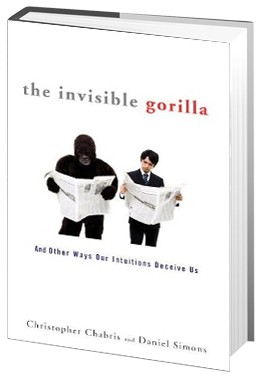
These and much more are grist for Christopher Chabris and Daniel Simons’ new book, The Invisible Gorilla, an exploration of the distortions and outright illusions that accompany our individual and collective perceptions and memories. Don’t be fooled, note the authors: our brains are not cameras—they construct and reconstruct memories and perceptions with creative aplomb—sometimes they addeth; other times they taketh away.

If the shoe won’t fit . . . Reading the New York Times’ thumbs-up review of the book several Sundays ago ignited my own memory of perhaps the greatest collective illusion of the Cold War era. Remember footage or photos of Khrushchev banging his shoe during his 1960 speech at the United Nations? Nikita with shoe is one of the iconic images of the era. But according to former Washington Post journalist Peter Carlson in his entertaining K Blows Top, there was no video and no photo of the “act.” Alas, we’ve inherited just one photo of the shoe—a loafer, which sits inertly on the desk in front of K.

Khrushchev’s son, Sergei, who has lived in the United States since 1991, notes Carlson, regularly asks audiences if they recall images of his father banging the shoe. “I say, please raise your hand if you saw it, and many people raise their hands. They really think they saw it,” he remarks in Carlson’s book. Try your own version of the question at your next party. Some of your friends will bet the house that they saw K’s shoe in action. Their certainty will reflect  the viral potency and reinforcement of the human herd's collective memories.


Two weeks ago, I became excessively agitated upon discovering the Web photo (above right) of Khrushchev in the act—so agitated that  I emailed Khrushchev’s biographer, William Taubman, at Amherst College. The professor’s response was decisive:

I'm certain it's been photoshopped. Because even if he did bang his shoe (which I doubt), he is alleged to have done so while seated at a desk rather than standing at the lectern. But after interviewing a lot of people about the whole episode (many of them after my K bio came out), I believe K only brandished his shoe but did not bang it.

Learn how Professor Taubman arrived at his conclusions in his sparkling, meticulous opinion essay in the July 26-27 issue of the International Herald Tribune here.

A Note to Self-Important Photoshoppers. Be advised that Photoshopping a loafer into K’s hand and launching the photo into cyberspace may reflect your affinity for a consummate Stalinist tradition. Prominent party members among Stalin's millions of purged victims regularly got the air brush in official photographs. Consider the before-and-after frames below of Nikolai Yezhov, head of the NKVD (forerunner of the KGB), who was purged in 1939 and executed in 1940. The photos are highlights in the Newseum’s intriguing Web exhibit, The Commissar Vanishes. Visit it here.


And take it from Chabris and Simons—getting a handle on perception and memory can be a tall order unto itself. Additional “noise” is not required. Please hold the Photoshop!

Subscribe to Wig & Pen.